
FIRO structures the preparation, review and approval of sales forecasts within a single environment. Planning information stays consolidated and traceable, and the process runs in a governed, consistent way.
A single planning process spans every stage, from the initial version to final approval.
Every figure keeps its source, its author and its change history.
Planning, Demand and Supply Chain work on the same baseline.
Versions, approvals and assumptions are recorded permanently.
The official projection lives in a single system, with integrated information and no parallel copies.
Proven in demanding planning environments. Its S&OP process model applies to consumer goods, distribution, healthcare and industry.
S&OP aligns commercial projections with operational capacity and the organization’s financial goals. Sustaining that process on scattered files makes it fragile.
Multiple copies of the same number, with no way to know which is official.
You can’t reconstruct who changed what, or why.
Approvals happen by email or verbally, with no record.
Scenarios and assumptions overwrite each other and get lost.
FIRO consolidates demand projection, scenario management and financial analysis in a single environment, bringing into one orderly process what is solved today with spreadsheets, emails and disconnected tools.
Editable grid to plan month by month by product, channel and version. Automatic limit checks, copy & paste from Excel and a read-only analytical view.
The control center of the cycle. Each version is a complete scenario —Forecast, Budget, operating plan or ad-hoc— with the option to carry the base period from one cycle to the next.
The single source that feeds all planning: channels, SKU catalog, inventory, multi-currency exchange rates, prices, costs, increments, discounts and actuals.
A P&L financial dashboard that turns the forecast into results, comparing projection against actuals and versions against each other, in a read-only view.
Advanced multidimensional analysis on the same data, to compare versions side by side and examine deviations against budget with depth and agility.
Load large data volumes through predefined templates, with background processing that keeps the operation smooth during import.
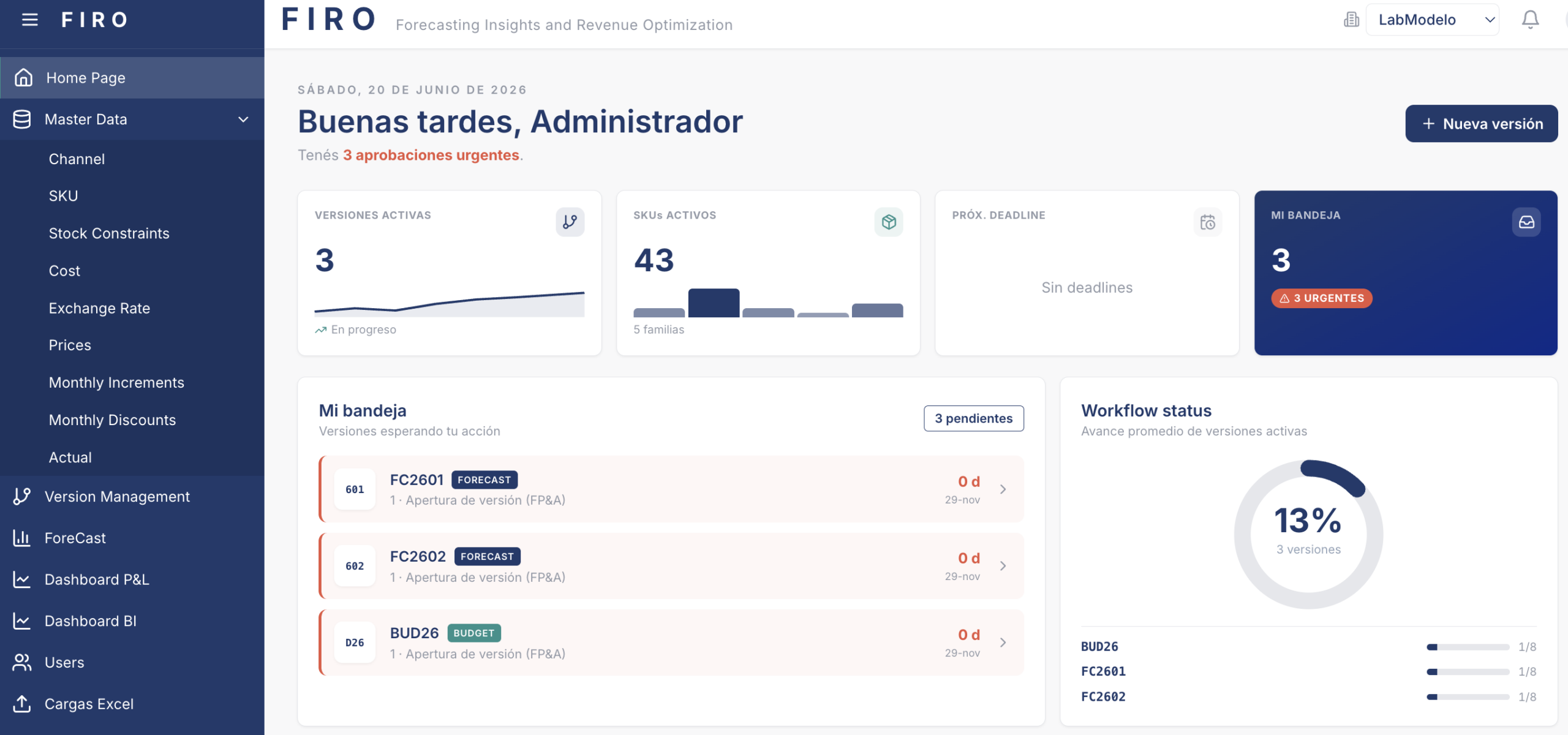
The same screens the planning team works with, on sample data.
Eight sequential steps, with defined owners and validations that ensure every decision moves forward on approved data.
Opens the cycle and enables data entry for the rest of the participants.
Completes the projection for their product family and sends it to the BU Director.
Approves or rejects; requires approval from both business units.
Validates feasibility against inventory and adjusts stock and forecast.
Reviews and adjusts price lists to secure margins; approval only.
Checks the consistency of projected units against budget.
Assesses the effect on revenue, costs, margins and P&L.
Final review: their decision closes the cycle or restarts it.
Once a step is approved, lower-tier users cannot change their data. The only way to reopen it is a rejection by the upper validator.
Once both business units are approved, the Supply Chain and Pricing stages move in parallel, shortening cycle time without losing control.
Six defined profiles that collaborate on a single version, each with permissions scoped to their responsibility.
Broadest scope and unrestricted access: manages the version lifecycle and the financial evaluation of the plan.
Enters the projections for the assigned product family; their involvement is limited to the Forecast.
Reviews and decides on what their business unit submitted, without changing the data.
Validates feasibility against stock and adjusts inventory and forecast where needed.
Reviews and adjusts price lists to secure margins; their action is approval.
Last reviewer in the flow: closes the cycle or restarts it with their final decision.
Uncertainty is inherent to any commercial projection. FIRO structures planning around formal scenarios that coexist within each version without interfering with one another, keeping the traceability of every hypothesis and the ability to compare them directly.
Up to five upside and five downside scenarios per version: ten alternative situations modeled at the same time, without altering the base plan data.
Demand with no stock constraints, revealing the full market potential.
The plan adjusted to real inventory constraints. The base scenario of every version.
The conservative view that quantifies downside risks, on top of the base scenario.
The effect of extraordinary commercial efforts —tenders, launches— added on top of the base scenario.
FIRO automatically walks the chain that links demand projection to the income statement, giving full traceability from the unit to the margin.
The projections entered month by month by product, channel and scenario form the basis of the calculation.
Each unit is multiplied by its price and adjusted with increments, compound discounts and taxes.
Values are expressed in the analysis currency by applying the defined exchange rates.
The valued revenue is matched against product costs to obtain Net Sales.
The difference between Net Sales and cost determines the margin, comparable across versions and against actuals.
FIRO builds governance into the heart of the process. Permissions, edit locks and validations operate automatically as the cycle advances, and every action is recorded with its author, its timing and its context. The organization keeps consolidated information and full control over the data and its deployment.
The P&L dashboard and the BI dashboard read exactly the same information as the planning operation. No reconciliations or intermediate exports: what gets approved is what gets analyzed.
Artificial intelligence doesn’t generate the plan: it reviews it. It evaluates forecast accuracy, detects anomalies and highlights the deviations that deserve attention, so the team can decide with better information.
Measures how accurate the projections are against actuals and their evolution by period, product and channel.
Identifies atypical entries, unexpected jumps and out-of-pattern values before they advance through the approval flow.
Highlights the relevant deviations against budget and across versions, focusing on what needs review.
The decision always belongs to the team: AI provides analytical insight and alerts, it doesn’t automate judgment.
FIRO replaces the mix of spreadsheets, emails and manual processes —or complements existing ERPs— with a platform designed for the S&OP process. Adoption is gradual, without losing the knowledge already built around the process.
The process and master data are assessed, and product families, business units and roles are configured to match the organization’s structure.
Historical and current information is moved from the current sources into a common, consolidated repository.
Roles and the eight-step workflow are enabled, and the team starts running the cycle with full governance and traceability.
